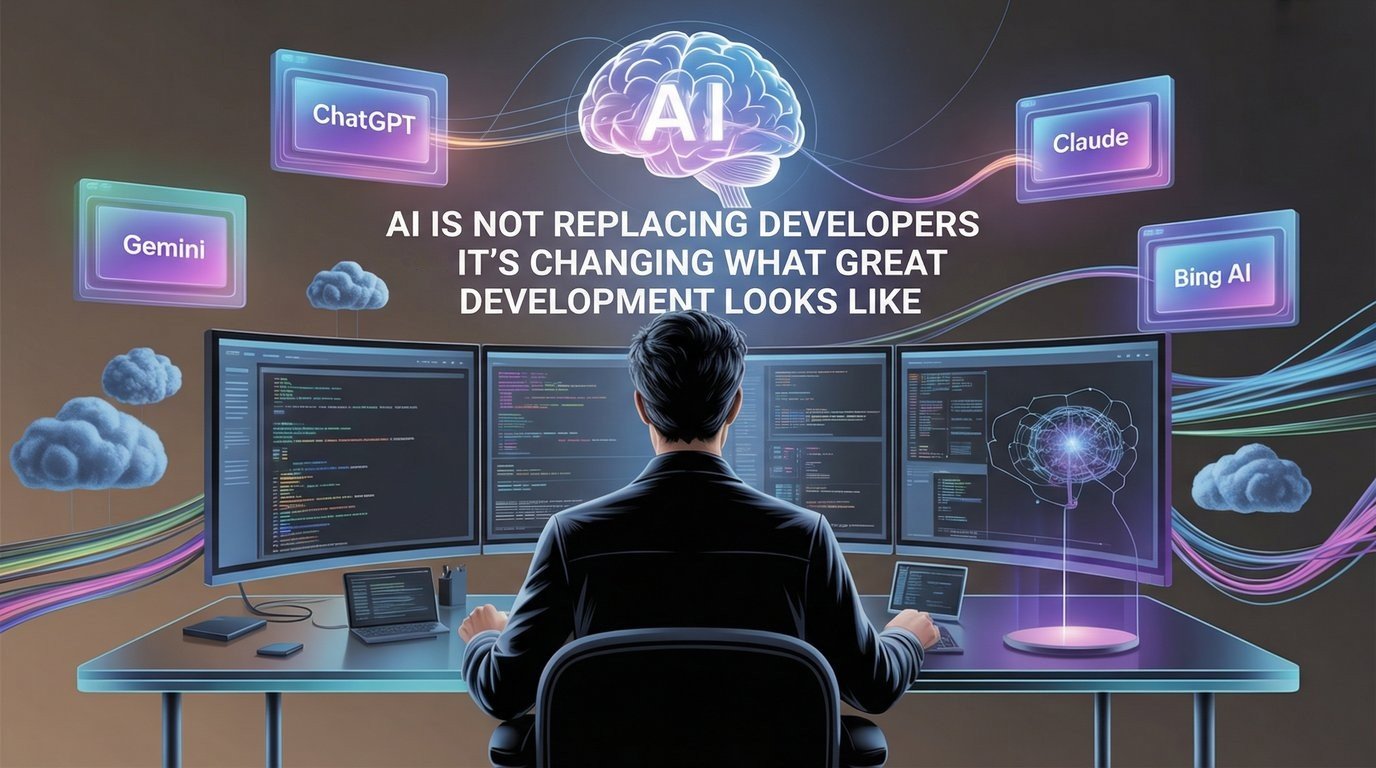
Introduction: The Fear vs The Reality
Let's be honest.
When AI tools started writing code, debugging errors, and even generating entire
applications, many developers felt a chill down their spine. "Is this the beginning of the
end?"
It's a fair question.
But here's the truth: AI is not replacing developers. It's reshaping what great development
actually means.
Think of AI as a power tool. A power drill doesn't replace the carpenter. It just helps them
build faster and better. The same logic applies here.
The Rise of AI in Software Development
From Automation to Intelligent Assistance
AI in development didn't appear overnight. It evolved.
First, we had automation scripts. Then smart IDE suggestions. Now we have AI systems capable
of generating functions, explaining code, and even building prototypes.
But here's the key difference: AI assists. It doesn't decide.
It suggests. It doesn't own responsibility.
And that distinction matters.
The Role of AI Chatbots in Modern Development
AI chatbots are becoming everyday tools in development workflows. They help:
Generate boilerplate code
Refactor legacy systems
Explain complex algorithms
Debug
faster
But can they fully understand your client's business logic? Can they negotiate trade-offs
between scalability and budget?
Not quite.
An AI chatbot is like a junior developer who works fast — but still needs supervision.
What Is the 30% Rule in AI?
You may have heard about the "30% rule" in AI.
Understanding AI's Contribution vs Human Oversight
The 30% rule suggests that AI can handle roughly 30% of repetitive, predictable, and
structured development tasks efficiently.
These include:
Code generation
Basic debugging
Unit test creation
Documentation drafts
That's powerful.
But it's not everything.
Why the Remaining 70% Still Belongs to Developers
The remaining 70% includes:
Architectural decisions
Business logic modeling
Security trade-offs
Performance
optimization
Ethical considerations
AI can suggest. But it cannot fully understand context.
And context is everything in software development.
Why AI Will Not Replace Programmers
Let's tackle this directly.
AI Lacks Context and Business Judgment
Software is not just code. It's strategy.
A payment system for a startup in India is different from one in Silicon Valley. Regulations,
customer behavior, scalability needs — these vary.
AI does not inherently understand business nuance.
Developers do.
Creativity and Problem-Solving Still Require Humans
Innovation doesn't come from pattern repetition alone.
It comes from:
Asking "What if?"
Challenging assumptions
Designing new workflows
AI works on patterns from past data. Developers imagine the future.
That's a huge difference.
Responsibility, Ethics, and Ownership
When something breaks, who is accountable?
The AI? No.
Developers, architects, and organizations carry responsibility.
Ethical design, privacy protection, and system safety cannot be outsourced to algorithms.
The Evolving Role of the Developer
Now here's the exciting part.
Developers are not becoming obsolete. They're becoming more powerful.
From Code Writer to System Architect
Previously, being a "great developer" meant writing clean, efficient code.
Today?
It means designing systems that integrate APIs, AI services, microservices, cloud
infrastructure, and user experience.
Less typing. More thinking.
From Executor to Strategic Thinker
AI can execute.
But developers must think strategically:
Is this scalable?
Is this secure?
Is this future-proof?
The job is shifting from mechanical coding to intelligent orchestration.
AI Collaboration as a Core Skill
Tomorrow's top developers won't just know Python or JavaScript.
They'll know how to collaborate with AI tools effectively.
Prompt engineering. Validation. Optimization.
Working with AI will become a core competency.
Which Country Is No. 1 in AI?
Now let's zoom out.
The AI revolution isn't just about individuals. It's global.
The Leadership of the United States
The United States currently leads in AI innovation, research funding, and enterprise
adoption.
Major tech giants, research labs, and startups drive AI advancements from Silicon Valley to
New York.
The Rapid Rise of China
China is investing aggressively in AI infrastructure, government initiatives, and large-scale
deployment.
It competes closely with the US in AI research publications and applied AI systems.
The Global AI Race and What It Means for Developers
Countries like the UK, India, Canada, and Germany are also investing heavily.
This global race means one thing for developers:
AI skills are becoming globally valuable.
The opportunity is massive.
AI Chatbots: Assistant, Not Replacement
Let's revisit AI chatbots.
Code Generation and Debugging
They can write:
CRUD operations
REST APIs
Sorting algorithms
But they can also generate flawed code.
Blind trust is dangerous.
Verification remains human.
Documentation and Testing
AI excels at:
Drafting documentation
Writing test cases
Generating examples
This saves time — sometimes hours per week.
Productivity Multiplier Effect
Think of AI like a productivity multiplier.
If you were a 7/10 developer before, AI might push you to 9/10 in speed.
But it won't magically turn a beginner into a system architect overnight.
Skill still matters.
How Great Development Is Redefined
So what does "great" look like now?
Speed + Strategy
Speed alone isn't enough.
Strategy alone isn't enough.
The winning formula is both.
AI accelerates speed. Humans provide strategy.
Human Insight + Machine Efficiency
It's like driving a race car.
The engine (AI) is powerful. But without a skilled driver (developer), it crashes.
Continuous Learning as a Competitive Edge
The AI landscape changes fast.
Developers who adapt will thrive.
Those who resist may struggle.
Learning is no longer optional. It's survival.
The Skills Developers Must Build in the AI Era
Let's get practical.
Prompt Engineering
Knowing how to ask AI the right questions is becoming a superpower.
Clear prompts = better outputs.
Vague prompts = messy code.
System Design and Architecture
AI can generate components.
But only experienced developers can design:
Distributed systems
Scalable infrastructures
Secure architectures
This is high-value work.
Critical Thinking and Validation
AI can hallucinate.
Developers must verify.
Testing, reviewing, and validating outputs will become even more essential.
The Future of Development Teams
What will teams look like in five years?
Smaller Teams, Bigger Output
AI will increase productivity.
This may mean leaner teams delivering larger projects.
But expertise will matter more, not less.
AI-Augmented Workflows
Daily workflow may look like:
Define requirement
Prompt AI
Review output
Optimize
Deploy
Human oversight remains central.
Human Leadership Remains Essential
Leadership, communication, and stakeholder management cannot be automated easily.
Developers who understand business will dominate.
Powerful AI Tools Developers Are Using Today
Let's talk about the real players in the room.
AI isn't just a concept anymore — it's a toolbox. And developers worldwide are already using
these tools daily to build faster, debug smarter, and think bigger.
ChatGPT by OpenAI
ChatGPT has become a daily coding companion for many developers.
Here's how it helps:
Generates boilerplate code in seconds
Explains complex functions clearly
Refactors
messy code
Suggests optimization strategies
Helps learn new frameworks quickly
It's like having a senior developer available 24/7 — minus the coffee breaks.
But remember: it suggests. You decide.
Gemini by Google
Gemini is deeply integrated into Google's ecosystem.
Developers use it for:
Code generation inside development environments
AI-assisted research
Cloud-based AI
integration
Data analysis and automation
Because it connects seamlessly with Google Cloud services, it's especially powerful for teams
building scalable AI-driven applications.
It's not just about writing code. It's about connecting systems intelligently.
Claude by Anthropic
Claude is known for its strong reasoning and safety-focused design.
Developers often use it for:
Long-context analysis
Documentation drafting
Reviewing large codebases
Brainstorming
architectural ideas
Claude shines when you need thoughtful, structured responses rather than just quick snippets.
Think of it as the calm, analytical architect in the room.
Bing AI by Microsoft
Bing AI integrates conversational AI with live web data.
Developers use it to:
Research updated documentation
Compare libraries
Explore real-time technical
solutions
Validate implementation approaches
It combines search + AI reasoning — making research faster and more contextual.
Less tab-switching. More building.
Antigravity and Emerging AI Developer Tools
New AI platforms like Antigravity and other AI copilots are focusing on:
Automated full-stack app generation
Workflow automation
UI scaffolding
AI-assisted
DevOps
These tools aim to reduce setup time dramatically.
Imagine spinning up a project structure in minutes instead of hours.
That's where things are heading.
Conclusion
AI is not here to replace developers.
It's here to challenge them.
To upgrade them.
To push them beyond repetitive coding into strategic, creative, and architectural roles.
The 30% rule reminds us that automation covers tasks — not vision.
Countries like the United States and China may lead the AI race, but individual developers
hold the real power.
Because at the end of the day, AI is a tool.
And tools don't build the future.
People do.
FAQs
1. What is the 30% rule in AI?
The 30% rule suggests that AI can automate around 30% of repetitive and structured
development tasks, while the remaining 70% requires human expertise, judgment, and strategic
thinking.
2. Why will AI not replace programmers?
AI lacks context awareness, creativity, ethical reasoning, and business understanding.
Developers provide decision-making, accountability, and innovation that AI cannot fully
replicate.
3. Which country is number one in AI?
The United States currently leads in AI innovation and enterprise adoption, while China is
rapidly advancing and competing closely.
4. Are AI chatbots useful for developers?
Yes. AI chatbots help with code generation, debugging, documentation, and testing. However,
their output must always be reviewed and validated by developers.
5. What skills should developers focus on in the AI era?
Developers should focus on system design, prompt engineering, critical thinking, architecture
planning, and strategic problem-solving.
 GROOT
TECHNOLOGIES
GROOT
TECHNOLOGIES