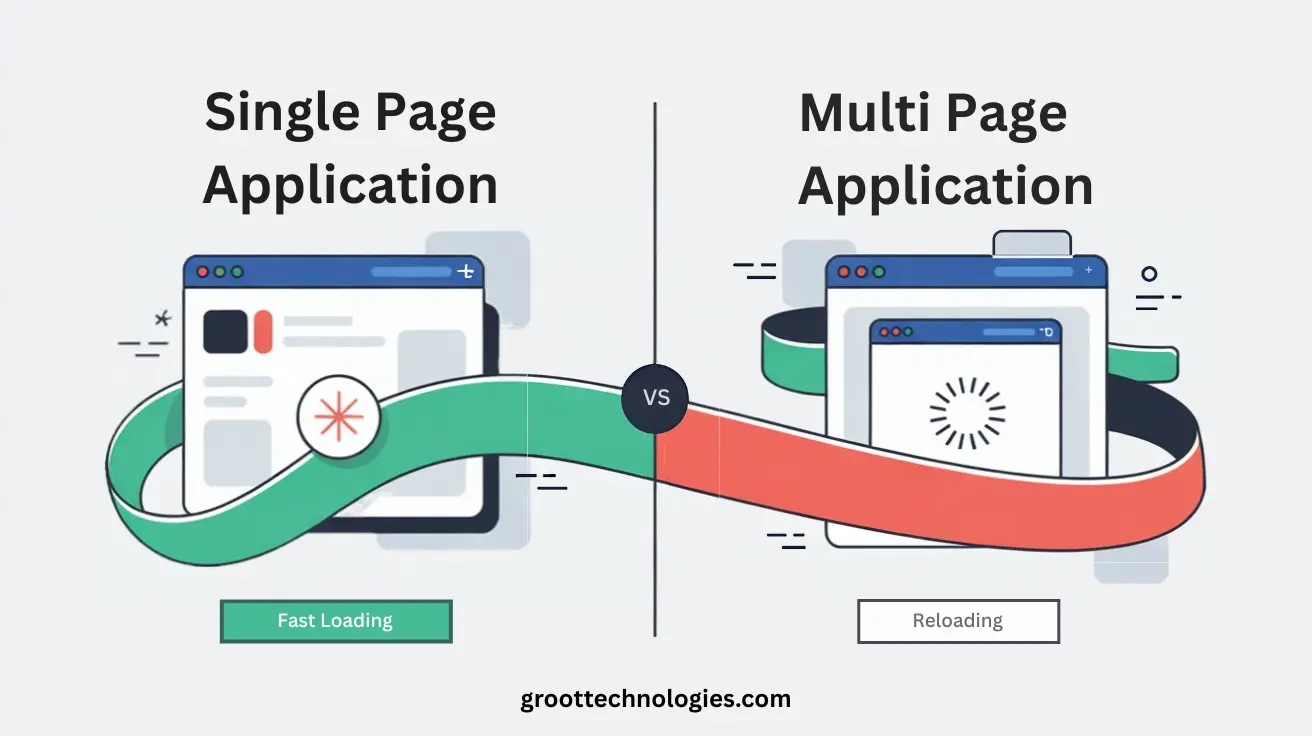
💡 Introduction to SPA vs MPA
If you're a founder building a digital product, the choice between a single page
application vs multi page application isn’t just a technical decision—it’s a
business decision. Think of your website or app like your storefront. Would you prefer a
sleek, fast-moving showroom where customers glide seamlessly between sections, or a
traditional store where each section feels separate but structured?
That’s essentially the difference between SPA and MPA.
In today’s fast-paced digital environment, users expect lightning-fast experiences. Studies
show that even a 1-second delay in load time can reduce conversions by up to 7%. That’s not
a small number when you’re scaling a startup. Your choice here affects SEO rankings, user
experience, development cost, and scalability—all critical factors for growth.
As a founder, you don’t need to code—but you do need to understand the implications. Whether
you're building a SaaS platform, eCommerce store, or corporate website, this decision shapes
how users interact with your brand. So let’s break it down in simple, non-technical terms.
📱 What is a Single Page Application (SPA)?
A Single Page Application (SPA) is a website that loads once and then updates content
dynamically without refreshing the page. 🔄
👉 How SPA Works
Instead of loading a new page from the server every time you click something, an SPA:
- Loads a single HTML page initially.
- Uses JavaScript to update content instantly.
- Feels like a mobile app operating directly in the browser.
🌟 Popular SPA Examples
These apps feel incredibly fast and smooth because they don’t reload
pages every time you interact with them.
🌐 What is a Multi Page Application (MPA)?
A Multi Page Application (MPA) is the traditional type of website where every action
loads a completely new page from the server. 🌍
👉 How MPA Works
- Each click = a new page request.
- The server sends a fully new HTML page.
- The browser page reloads completely.
🌟 Popular MPA Examples
E-commerce websites
(Amazon)
⚖️ SPA vs MPA: Key Differences
⚡ Performance Comparison
When comparing single page application vs multi page application, performance
depends heavily on how users interact with your app.
SPAs load faster after the first interaction because they don’t
reload entire pages. This creates a smooth and app-like experience. However, the
initial load can be slightly heavier due to JavaScript bundles.
MPAs, on the other hand, reload pages every time,
which can feel slower. But they distribute content across multiple pages,
reducing the initial load burden.
🎨 User Experience Comparison
User experience is where SPAs shine. Navigation feels instant,
transitions are smooth, and interactions are fluid. It’s exactly like comparing
a modern smartphone app to a basic website.
MPAs provide a more traditional experience. While
they might not be as fluid as SPAs, they are often more predictable and easier
to navigate for users familiar with standard website layouts.
🔍 SPA vs MPA vs SSR Explained
What is Server-Side Rendering (SSR)?
Server-Side Rendering (SSR) is like a hybrid approach. Instead of rendering content
entirely in the browser (like a standard SPA), the server generates the full HTML page
before sending it to the user.
This means users see content faster, and search engines can easily crawl and index the
page, solving one of the major drawbacks of SPAs.
When SSR Fits Best
SSR is the ideal choice when:
SEO is critical
for your business success.
You want blazing-fast
initial load times.
You need dynamic content
with better indexing.
Note: Frameworks like Next.js have made SSR extremely
popular, especially for startups aiming to balance high performance and solid
SEO.
🔎 Which is Better for SEO?
This is where the single page application vs multi page application debate gets serious.
🟢 MPA Wins for SEO
Why?
- Each page has
its own unique URL.
- Easier for
Google bots to crawl.
- Better
traditional indexing capabilities.
🔴 SPA Challenges
Why?
- Content
loads dynamically via JavaScript.
- Search
engines may struggle to wait for rendering.
- Requires extra
setup (like SSR or Pre-rendering) for SEO optimization.
👉 Tip: Use SSR or pre-rendering if you choose SPA and care
deeply about organic SEO traffic.
⚡ Load Speed and Performance Analysis
Speed is everything. Users expect pages to load in under 3 seconds, and anything slower
increases bounce rates dramatically.
SPAs offer faster interactions after the initial load, making them ideal for
apps with frequent user actions. MPAs may feel slower due to page reloads
but can optimize individual pages effectively.
The key takeaway? Speed depends on implementation and
optimization, not just architecture.
💰 Cost to Build and Maintain
Cost is where things get interesting for founders determining their budget.
SPAs typically require:
- More
complex development processes.
- Highly
skilled JavaScript developers.
- Ongoing backend
API maintenance.
MPAs are often:
- Easier
to develop initially.
- Cheaper for
simple, straightforward projects.
- More
scalable for content-heavy sites without robust APIs.
However, long-term costs depend entirely on your product’s complexity and
maintenance needs.
🧰 Popular Frameworks of SPA & MPA
MPA Frameworks
- Laravel
- Django
- Ruby on Rails
🎯 Best Use Cases: When to Use Which?
Best for SPA
SPAs are absolutely perfect for:
- SaaS platforms
- Interactive Dashboards
- Social media applications
- Real-time chat or tracking applications
If your product requires constant user interaction without
refreshing, SPA is the way to go.
Best for MPA
MPAs work best for:
- Blogs and content websites
- Large eCommerce platforms
- Corporate informational websites
- News portals
If SEO, structured content, and discoverability matter most,
MPA is a very strong choice.
🤔 How to Choose the Right One for Your Business
Choosing between single page application vs multi page application ultimately comes down
to your primary business goals.
Ask yourself these crucial questions:
Do you need strong SEO?
(Lean towards MPA or SPA with SSR)
Is user interaction critical?
(Lean towards SPA)
What’s your budget?
(MPA is generally cheaper initially)
How fast do you want to scale feature sets?
(SPA offers great frontend flexibility)
If you’re building a product-driven, interactive platform,
SPA might be your best bet. If you’re focused heavily on content and
search visibility, MPA is likely the better choice.
❓ FAQs
1. What is the main difference between SPA and MPA?
👉 SPA loads one page and updates content dynamically without refreshing, while MPA
reloads a completely new page from the server for every action.
2. Which is better for SEO: SPA or MPA?
👉 MPA is generally better for traditional SEO because each page is indexed separately.
However, SPA can achieve excellent SEO when using Server-Side Rendering (SSR).
3. Is SPA faster than MPA?
👉 Yes, SPA is faster after the initial load because it dynamically fetches only what it
needs, but the very first load may be slower compared to MPA.
4. Can SPA be SEO-friendly?
👉 Absolutely. With SSR frameworks (like Next.js) or pre-rendering techniques, SPAs can
significantly improve their SEO performance and indexability.
5. Which is cheaper to build?
👉 MPA is usually cheaper initially due to simpler infrastructure, while SPA may cost
more upfront due to complex frontend and backend separation.
6. What is SSR and why is it important?
👉 Server-Side Rendering (SSR) renders pages on the server instead of the browser. It
drastically improves both initial page load speed and SEO crawlability for SPAs.
🏁 Conclusion
The debate between single page application vs multi page application
isn’t about which is inherently better—it’s about which is better for you. Each
approach has significant strengths and specific trade-offs, and the right choice depends
heavily on your business model, target audience, and long-term growth strategy.
Think of SPA as a high-performance sports car—fast, smooth, highly interactive, and
modern. MPA is more like a reliable SUV—structured, dependable, easily recognizable, and
built for long journeys.
The smartest founders don’t just follow technical trends—they choose the
architecture that aligns perfectly with their business goals.
Still unsure which path to take for your next project?
Our technical experts can help you analyze your requirements and
recommend the perfect architecture for your business goals.
Let’s Discuss
Your Project
 GROOT
TECHNOLOGIES
GROOT
TECHNOLOGIES